
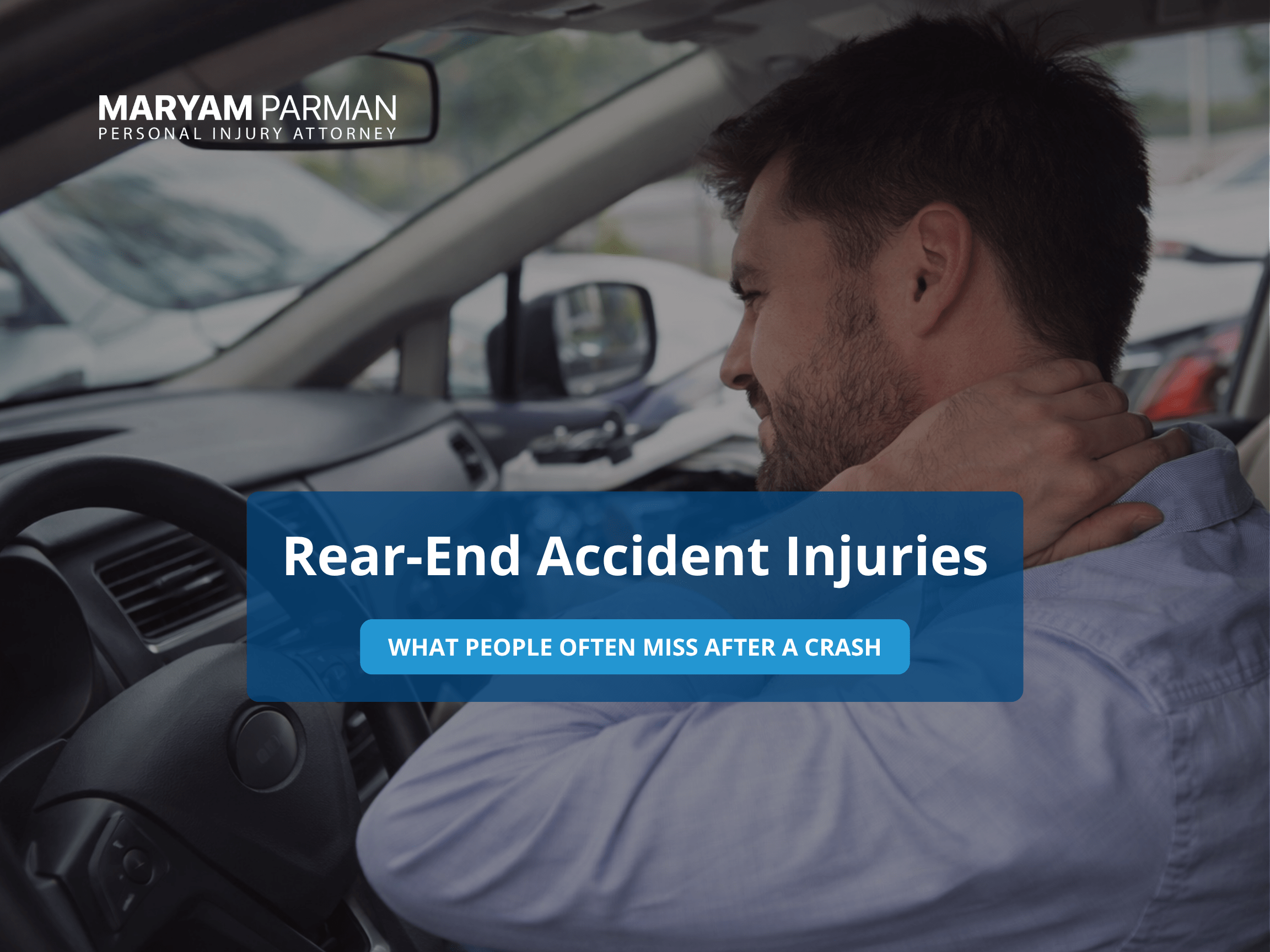
Rear end accident injuries are often underestimated until symptoms begin to affect daily life. Many people walk away from these crashes believing they’re fine, especially when the damage to the vehicle appears minimal. But what happens to the body during a rear-end collision is very different from what happens to a car.
In reality, even low-speed impacts can create strain on muscles, ligaments, and the spine. The problem is that these injuries don’t always show up immediately. By the time symptoms develop, insurance companies may already be questioning whether the injury is connected to the accident at all.
Why Rear-End Collisions Are So Often Misunderstood
Rear-end accidents are one of the most common types of crashes. Because they happen so frequently, they’re often treated as minor incidents.
But the mechanics of a rear-end collision tell a different story.
When a vehicle is struck from behind, the body is forced forward and then snapped backward. This rapid motion places stress on:
- The neck
- The spine
- The upper back
- Surrounding muscles and connective tissue
Rear end accident injuries can develop from this motion even when the collision speed is relatively low.
Insurance companies often rely on visual cues like vehicle damage, but those cues don’t accurately reflect how force is transferred through the body.
The Injuries That Don’t Show Up Right Away
One of the biggest challenges with rear end accident injuries is timing. Symptoms often don’t appear immediately.
Common delayed injuries include:
- Whiplash
- Soft tissue damage
- Herniated discs
- Headaches or dizziness
- Nerve-related pain
According to the Centers for Disease Control and Prevention, many crash-related injuries may not present symptoms right away, especially soft tissue injuries that develop over time.
This delay creates a gap between the accident and the symptoms — and that gap is often used by insurers to question the claim.
How Insurance Companies Evaluate Rear-End Claims
Insurance companies look for patterns and documentation, not assumptions.
They often evaluate:
- When treatment began
- Whether symptoms were reported immediately
- Consistency of medical care
- Severity of vehicle damage
Rear end accident injuries that are not documented early can be minimized or challenged.
For example:
- If you wait to seek care, they may argue the injury is unrelated
- If symptoms change over time, they may question credibility
- If imaging doesn’t show damage, they may downplay the injury
This is not unusual — it’s part of how claims are processed.
Why Documentation Matters More Than People Expect
Documentation is what connects the accident to the injury.
Strong documentation includes:
- Early medical evaluation
- Consistent treatment records
- Notes about symptoms over time
- Clear communication with providers
Without this, rear end accident injuries become harder to prove.
Working with a car accident lawyer early can help ensure that these details are captured properly and consistently.
Why This Matters in Real Cases
In real cases, small differences early on can lead to very different outcomes.
Consider two scenarios:
- One person seeks treatment immediately and documents symptoms
- Another waits several days, assuming the pain will pass
Even if the injuries are similar, the second claim is often more difficult to support.
Rear end accident injuries are not just about what happened in the crash — they are about how clearly the impact is documented afterward.
What People Often Misunderstand
There are several assumptions that lead to problems in these cases.
“If I feel fine right now, I must not be injured.”
Symptoms often take time to develop.
“My car isn’t badly damaged, so I’m not seriously hurt.”
Vehicle damage doesn’t reflect how the body absorbs force.
“Insurance will take care of everything.”
Insurance companies evaluate claims based on evidence, not expectations.
“I can deal with it later.”
Delays often make claims harder to prove.
These misunderstandings can reduce the value of a claim before the full impact of the injury is understood.
The Long-Term Impact of Ignoring Symptoms
Rear end accident injuries can become long-term issues when they’re not addressed early.
Some people experience:
- Chronic neck or back pain
- Limited mobility
- Ongoing headaches
- Difficulty returning to normal activities
What starts as a minor discomfort can become something more disruptive over time.
Once a claim is resolved, there is usually no opportunity to revisit it — even if symptoms worsen later.
FAQ About Rear End Accident
Can rear end accident injuries happen at low speeds?
Yes. Even low-speed impacts can create significant strain on the body.
What is whiplash?
It’s a rapid back-and-forth motion of the neck that can damage soft tissue.
Why do symptoms appear later?
Inflammation and muscle strain often take time to develop.
Should I see a doctor even if I feel okay?
Yes. Early evaluation helps protect both your health and your claim.
Can insurers deny delayed injuries?
They may try, especially if there is no early documentation.
Do I need imaging to prove injury?
Not always. Many injuries are diagnosed based on symptoms and exams.
What if I waited to get treatment?
You may still have a claim, but it may be more difficult to support.
Are rear-end accidents always the other driver’s fault?
Often, but not always. Each situation depends on the details.
A More Realistic Way to Look at Rear-End Accidents
Rear-end accidents are often treated as minor, routine events. But the impact on the body is not always obvious right away.
Rear end accident injuries can develop gradually, and how they are handled early on can affect both recovery and long-term outcomes.
Understanding that difference is what helps people avoid problems later.
Contact Maryam Parman Today

Rear-end accidents are often underestimated until symptoms begin to affect daily life.
If you’re dealing with pain, discomfort, or uncertainty after a crash, it may be worth taking a closer look at how your situation is being evaluated and whether anything is being overlooked.
Call now, start a live chat, or fill out a form to speak with Maryam Parman. Getting guidance early can help protect both your recovery and your financial future. Taking the right steps early not only protects your claim but also helps ensure that your recovery is supported financially and legally over time. the accident, not just the immediate damage. Even small decisions made early in the process can have long-term financial consequences after a car accident.
- Call Us: 844-672-7626
- Live Chat: Connect with us on our website for a case review.
- Fill Out a Form: Submit your details online for a free, no-obligation consultation.