
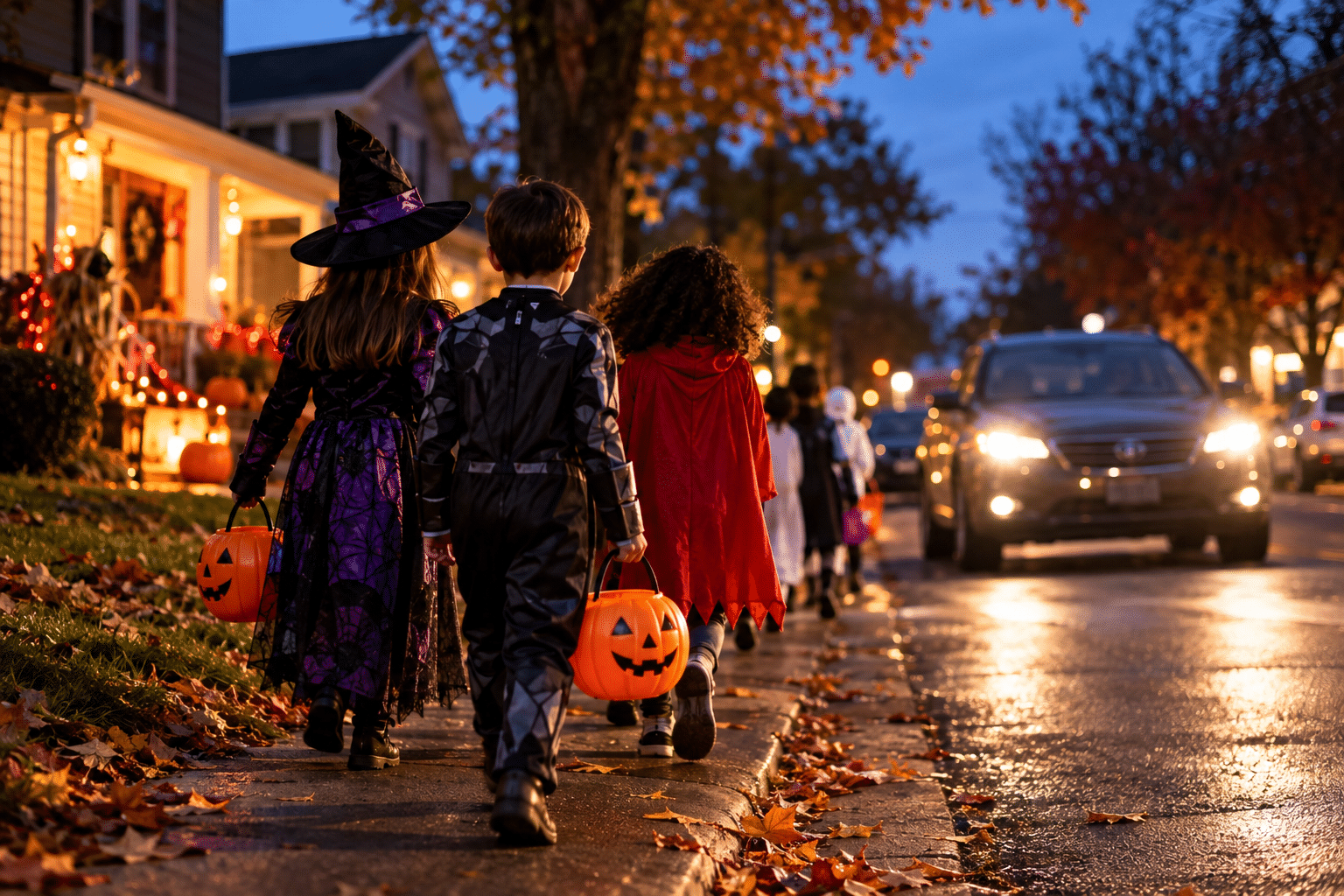
Halloween pedestrian accidents can turn an evening built around costumes, candy, and neighborhood traditions into a frightening experience for an entire family. On October 31, residential streets look different from almost any other night of the year. Children move between houses after dark, groups gather near driveways and intersections, parked cars can limit visibility, and drivers may encounter pedestrians in places where they do not normally expect them.
Most families are thinking about costumes, candy bags, and getting everyone home at a reasonable hour. They are not thinking about what they would do if a driver failed to slow down, backed out of a driveway without looking, or struck someone crossing the street.
When that happens, the questions come quickly. Who was responsible? Does it matter whether the pedestrian was in a marked crosswalk? What if a child moved unexpectedly? What evidence will the insurance company look at? And how do you protect an injury claim while your attention is understandably focused on medical care?
Those are not questions a family should have to answer based on assumptions. Halloween pedestrian accidents may happen in seconds, but determining what happened and how the injuries will affect the person who was hit can require a much closer look.
Why Halloween Creates a Different Pedestrian Environment
Halloween changes the rhythm of a neighborhood. Streets that may normally have modest evening foot traffic can suddenly be filled with families walking from house to house. Children may be excited, distracted by friends, wearing unfamiliar costumes, or carrying masks and accessories. At the same time, residents are arriving home from work, delivery vehicles are moving through neighborhoods, and people are driving to parties or other evening events.
The National Highway Traffic Safety Administration’s Halloween safety guidance specifically tells drivers to expect more pedestrians on the road and in unexpected places during Halloween. NHTSA advises motorists to slow down, scan the road, and watch for young trick-or-treaters who may enter the street unexpectedly. NHTSA also reports that nearly half of all crash fatalities on Halloween night in 2023 were alcohol-related.
The broader pedestrian numbers provide important context. According to NHTSA pedestrian safety data, 7,080 pedestrians were killed and more than 71,000 were injured in U.S. traffic crashes in 2024. NHTSA also advises drivers to use extra caution at night, slow down around pedestrians, yield at crosswalks, and be particularly careful when backing up.
Those numbers are not included to make Halloween sound frightening. They help explain why drivers need to adjust when the environment around them changes.
A driver traveling through a residential neighborhood at 7 p.m. on an ordinary Tuesday may encounter very few pedestrians. The same street on Halloween can look completely different. Reasonable driving requires responding to what is actually happening around the vehicle.
For families dealing with injuries after a collision, Maryam Parman’s pedestrian accidents practice page provides additional information about pedestrian injury cases and the legal help available after a serious collision.
What Liability Can Look Like After a Halloween Pedestrian Accident
After a pedestrian collision, people often want a simple answer about fault. Real cases are rarely decided by one detail alone.
The investigation may look at where the pedestrian was walking, where the vehicle was traveling, whether the driver was turning or backing up, available lighting, speed, sight lines, witness accounts, traffic controls, and what each person was doing immediately before impact.
Halloween adds another layer because the surrounding conditions are unusually important.
Imagine a driver entering a residential block filled with children. Cars are parked along both curbs. Groups are approaching intersections. Porch lights are on, and families are moving between homes. A driver who maintains the same speed and level of attention they might use on an empty street may not be responding appropriately to the circumstances.
A driveway collision can raise different questions. Did the driver check behind the vehicle? Was a child visible before the vehicle began moving? Were shrubs, parked vehicles, or other objects blocking the view? Was the driver distracted?
Intersections create still another set of facts. A pedestrian may have been crossing when a vehicle turned. A driver may claim the pedestrian appeared suddenly. Witnesses or nearby cameras may tell a different story.
This is why an injury claim should not be reduced to “the pedestrian was in the street” or “the driver had the right of way.” The full sequence matters.
And when a child is involved, families should be especially cautious about accepting an insurance company’s early version of events before the available evidence has been reviewed.
Why This Matters in Real Halloween Pedestrian Accident Cases
Halloween pedestrian accidents deserve careful attention because the circumstances are different from an ordinary evening. Drivers may encounter children where they would not normally expect them, pedestrian traffic can be heavier, visibility can be reduced, and the surrounding activity may create more opportunities for distraction.
NHTSA’s Halloween guidance reflects that reality by specifically telling drivers to expect trick-or-treaters and other pedestrians in unexpected places.
That matters because context matters.
If a neighborhood is visibly full of trick-or-treaters, pedestrian activity should not come as a surprise. Drivers still have to observe the roadway, adjust to conditions, and react appropriately to what is around them.
The same principle applies when visibility is reduced. Darkness does not automatically excuse a collision. Nor does a costume automatically make the pedestrian responsible. The question is what happened in that specific situation.
This is where evidence becomes more important than assumptions.
Doorbell cameras, security cameras, dash cameras, photographs, witness statements, police documentation, vehicle damage, and medical records can all help establish a clearer timeline. Some of that evidence may disappear quickly. A homeowner may overwrite video. A witness may forget details. A vehicle may be repaired.
Families do not need to become investigators while caring for someone who has been hurt. But understanding that evidence can be temporary is one reason early attention to the legal side of a serious pedestrian collision can matter.
What People Often Misunderstand About Pedestrian Fault
A common misconception is that a pedestrian must be in a marked crosswalk to have any legal protection. Another is that a driver who had the right of way cannot share responsibility for a crash. Neither assumption is a useful way to evaluate a real collision.
Fault depends on facts.
Insurance companies may focus heavily on pedestrian behavior because shifting some responsibility away from the driver can affect how a claim is evaluated. That makes statements given immediately after an accident particularly important.
A frightened parent may say, “He ran out so fast.” A driver may repeat that sentence to an adjuster. But what did “fast” actually mean? Where was the vehicle? How fast was it traveling? How long was the child visible? Did the driver brake? Was the driver looking toward the roadway?
Those details cannot be answered by a single emotional statement made at the scene.
Another misunderstanding involves injury severity. A pedestrian has no vehicle frame, seat belt, or airbag between their body and the impact. Even when a vehicle is moving relatively slowly, the resulting injuries can be substantial.
That is why early settlement discussions can be risky. A family may know what the emergency room cost but not yet know whether additional imaging, therapy, surgery, follow-up care, or time away from work will be necessary.
Maryam Parman’s personal injury accident resources provide additional context on how an injury claim can involve far more than the first round of medical bills.
What Families Should Protect After a Serious Pedestrian Collision
After an accident, medical care comes first. Everything else can feel secondary, and understandably so.
Still, a few pieces of information can become extremely important later.
Photos of the location can document lighting, parked vehicles, road markings, driveways, landscaping, and other visibility issues. Witness names and contact information can preserve independent accounts. Clothing and damaged personal items may also be relevant rather than something to immediately discard.
Medical documentation matters for a different reason. Injuries evolve. A person who initially has pain in one area may later discover another injury. A concussion may affect concentration or sleep. An orthopedic injury may interfere with school, work, sports, or ordinary routines.
The goal is not to turn recovery into a legal project. It is to avoid having the real impact of the injury disappear simply because it was never documented.
Families should also be careful with insurance conversations. An adjuster may sound compassionate and still be gathering information for a claim evaluation. There is a meaningful difference between providing necessary information and speculating about fault, recovery time, or whether an injury is “getting better” before the medical picture is clear.
Maryam Parman and her award-winning legal team approach pedestrian cases by looking beyond the first bill or the first insurance call. The important question is what the collision actually changed for the injured person and what will be required to help that person move forward.
How Halloween Pedestrian Accidents Can Affect a Family Beyond the Initial Injury
A pedestrian injury can affect more than the person who was hit.
A parent may need to miss work to attend medical appointments. A child may become afraid of crossing streets or walking through the neighborhood. Transportation arrangements may change. Sports, school activities, and family routines can be interrupted. If rehabilitation is needed, recovery can become part of the family’s schedule for months.
These consequences are easy to overlook when an insurance company focuses primarily on a stack of medical bills.
But a serious injury is not experienced as a spreadsheet.
For a child, missing a season of sports may mean losing an important source of confidence and connection. For an adult, being unable to drive or work can affect household finances and independence. For a parent caring for an injured child, the practical impact may include unpaid time away from work and significant changes at home.
This is part of why Maryam’s approach is especially relevant to a pedestrian case. Evaluating an injury means understanding the person behind the records, not simply adding up invoices.
That perspective also helps explain why a quick settlement can be difficult to evaluate. If the family does not yet know the long-term impact, it may be impossible to know whether the offer reflects what has actually been lost.
Frequently Asked Questions About Halloween Pedestrian Accidents
Are Halloween pedestrian accidents actually a concern?
Yes. NHTSA specifically warns that drivers should expect more pedestrians on the road and in unexpected places around Halloween, particularly young trick-or-treaters.
What if a child ran into the street?
That fact may be relevant, but it does not automatically resolve liability. Driver speed, visibility, location, reaction time, surrounding pedestrian activity, and other available evidence can all matter.
Does a pedestrian have to be inside a crosswalk to have a claim?
Not necessarily. Crosswalk location may be important, but liability should be evaluated using the complete circumstances rather than one fact in isolation.
What if the driver says they could not see the pedestrian because it was dark?
Reduced visibility is part of the driving environment. NHTSA specifically advises drivers to exercise extra caution at night because pedestrians can be harder to see and may appear suddenly. Whether visibility affected liability in a particular collision depends on the specific facts.
What evidence can help after a Halloween pedestrian accident?
Depending on the collision, useful evidence can include photographs, witness information, police documentation, doorbell or surveillance video, dash-camera footage, vehicle damage, clothing, and medical records.
What if the insurance company offers a settlement quickly?
A quick offer should be evaluated in light of the complete injury picture. If treatment is ongoing or the long-term effects are unclear, the family may not yet know the full financial and personal impact of the collision.
Can emotional effects matter after a pedestrian injury?
They can. A serious collision may affect sleep, confidence, mobility, school, work, and a person’s willingness to walk near traffic. Appropriate documentation can help establish those effects when they are part of the injury.
When should a family speak with a lawyer?
There is no single timeline that fits every case. When injuries are significant, fault is disputed, evidence may disappear, or an insurer is requesting statements or pushing an early settlement, getting legal guidance sooner can help the family understand what needs to be protected.
Contact Maryam Parman Today
Halloween pedestrian accidents can leave families dealing with far more than the shock of what happened on one night. Medical treatment, questions about fault, insurance pressure, and uncertainty about a child’s or loved one’s recovery can continue long after the costumes are put away.
If your family is dealing with a pedestrian injury after a Halloween collision, it may be worth taking a closer look at how the accident is being evaluated and whether the evidence and full impact of the injury are being considered.
Call now, start a live chat, or fill out a form to speak with Maryam Parman. Getting guidance early can help protect both your recovery and your financial future. Taking the right steps early not only protects your claim but also helps ensure that your recovery is supported financially and legally over time.
Contact Maryam Parman Today

Halloween pedestrian accidents can leave families dealing with far more than the shock of what happened on one night. Medical treatment, questions about fault, insurance pressure, and uncertainty about a child’s or loved one’s recovery can continue long after the costumes are put away.
If your family is dealing with a pedestrian injury after a Halloween collision, it may be worth taking a closer look at how the accident is being evaluated and whether the evidence and full impact of the injury are being considered.
Call now, start a live chat, or fill out a form to speak with Maryam Parman. Getting guidance early can help protect both your recovery and your financial future. Taking the right steps early not only protects your claim but also helps ensure that your recovery is supported financially and legally over time.
- Call Us: 844-672-7626
- Live Chat: Connect with us on our website for a case review.
- Fill Out a Form: Submit your details online for a free, no-obligation consultation.