
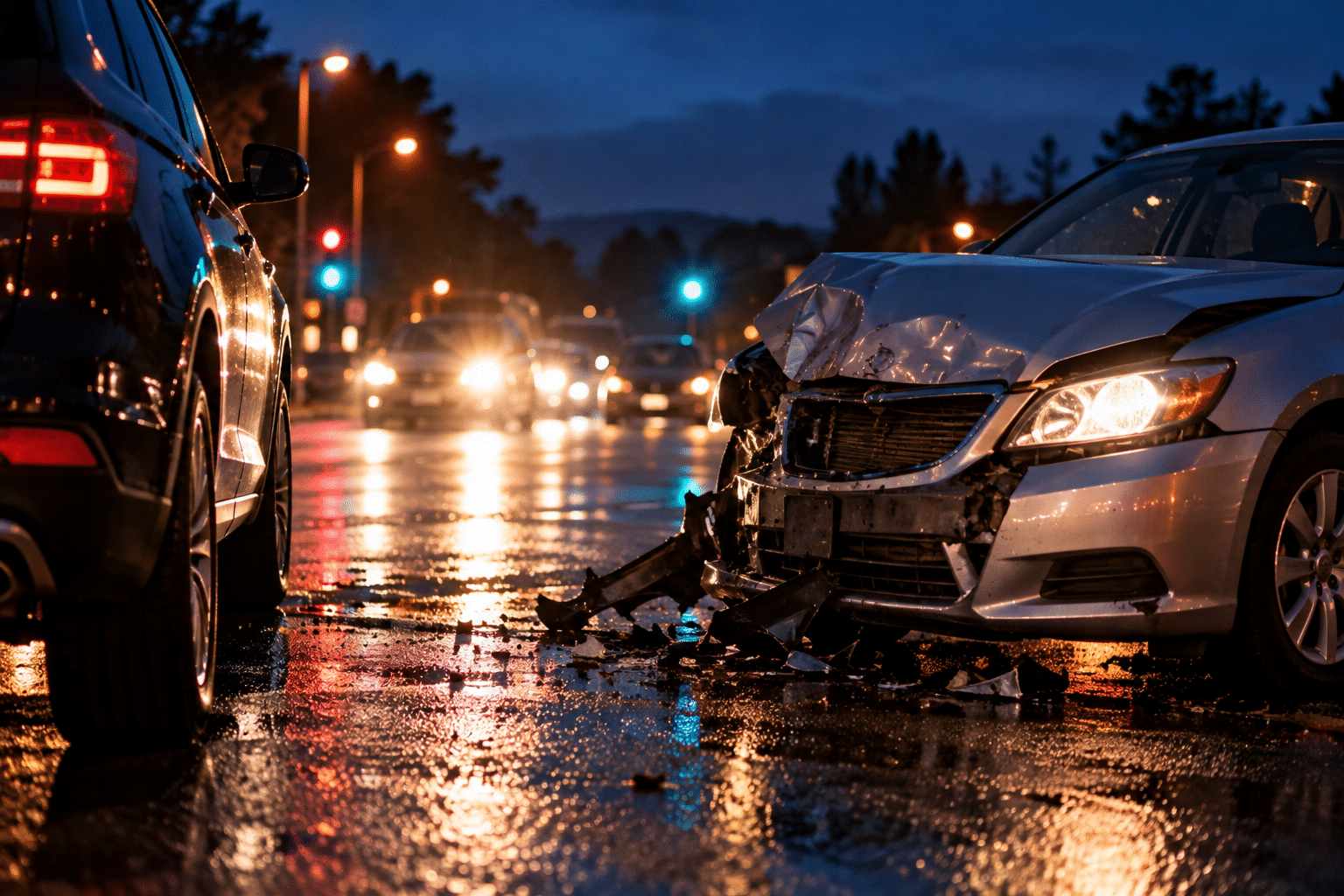
Car accidents after dark can become more complicated than daytime crashes because visibility, reaction time, and driver attention are often disputed from the beginning. As fall moves forward and daylight disappears earlier in the evening, more commuters find themselves driving home in darkness instead of daylight. The route may be familiar, but the conditions are not quite the same.
That distinction matters after a collision.
An insurance adjuster may say a pedestrian was difficult to see. A driver may claim another vehicle appeared suddenly. Someone making a left turn may insist they could not judge the approaching car’s speed because it was dark. In other cases, the discussion shifts to headlights, street lighting, glare, or whether a driver should have reduced speed.
Those details can make car accidents after dark harder to evaluate than they initially appear. Darkness does not determine fault by itself, but it can change what evidence matters and how an insurance company approaches a claim.
For Maryam Parman, the important question is not simply whether a crash happened at night. It is whether the people involved responded reasonably to the conditions that existed at the time.
Why Earlier Sunsets Change the Driving Environment
The seasonal change in daylight can feel surprisingly abrupt. A commute that took place in full daylight a few weeks earlier may suddenly happen after sunset. Drivers are still dealing with congestion, lane changes, intersections, pedestrians, cyclists, and merging traffic, but now they are doing so with less natural light.
The National Highway Traffic Safety Administration identifies visibility as an important roadway safety issue and provides guidance addressing nighttime driving and pedestrian visibility. That matters because darkness can make it more difficult to recognize hazards early enough to react safely.
But reduced visibility does not eliminate a driver’s responsibility to respond to road conditions.
If visibility is limited, the reasonable response may be to slow down, increase following distance, pay closer attention at intersections, and make sure headlights are functioning properly. A driver cannot simply maintain the same habits used in bright daylight and later argue that darkness made a collision unavoidable.
This distinction often becomes central in car accidents after dark.
Imagine a driver traveling through a busy commercial corridor shortly after sunset. Traffic is heavy. Pedestrians are crossing between parking areas and businesses. Headlights from opposing vehicles create glare. A reasonable driver should recognize that the environment requires more attention.
If that driver is speeding, looking at a phone, following too closely, or making a rushed turn, darkness may be part of the circumstances, but it is not necessarily the cause of the collision.
How Visibility Becomes Part of an Insurance Claim
Visibility arguments can become surprisingly detailed.
After car accidents after dark, insurance companies may ask whether headlights were on, whether streetlights were working, what color clothing a pedestrian was wearing, whether another vehicle had functioning taillights, or whether glare affected a driver’s view.
Some of those questions are legitimate. Others can be used to redirect attention away from negligent driving.
Suppose a pedestrian is struck while crossing an intersection. The driver says, “I couldn’t see them because it was dark.” That statement does not end the analysis.
Other questions matter.
How fast was the vehicle traveling? Was the driver turning? Was the pedestrian already in the roadway? Were there streetlights? Were other drivers able to see the pedestrian? Was the driver distracted? Did the driver brake before impact?
The same is true when two vehicles collide.
If one driver rear-ends another after sunset, the insurance company may discuss glare or visibility. But investigators may also need to consider following distance, speed, braking, traffic congestion, and whether the driver was paying attention.
People injured in these crashes can learn more about the broader claim process through Maryam Parman’s auto accidents practice page.
The point is not that visibility is irrelevant. It is that visibility should be evaluated as one part of the complete sequence.
Why This Matters in Real Car Accidents After Dark
Real claims are rarely as simple as “it was dark.”
Consider an evening intersection crash. One driver turns left across traffic and says the approaching vehicle was difficult to see. That may sound plausible until other evidence shows that the approaching vehicle had functioning headlights, the intersection was illuminated, and the turning driver was trying to beat a traffic signal.
Or consider a pedestrian collision. A driver may emphasize that the pedestrian was wearing dark clothing. But surveillance video could show that the pedestrian was visible for several seconds before impact while the vehicle continued without slowing.
These are examples of why evidence matters more than assumptions.
In car accidents after dark, photographs of the scene taken only during daylight may not tell the full story. Investigators may need to understand what the location actually looked like at the approximate time of the crash.
Street lighting can matter. Nearby businesses may have cameras. Traffic cameras, dash cameras, or surveillance footage may capture the collision. Vehicle data may help establish speed or braking. Witnesses may remember whether headlights were operating.
Evidence can also disappear.
Businesses routinely overwrite surveillance footage. Vehicles get repaired. Road conditions change. A broken streetlight may be fixed. Construction equipment may be moved.
That does not mean every nighttime collision requires an extensive investigation. It means serious or disputed claims deserve to be evaluated while the relevant evidence can still be found.
What People Often Misunderstand About Nighttime Fault
One misconception is that a crash caused by poor visibility is nobody’s fault.
That is not necessarily true.
Drivers are expected to adjust to the environment around them. Darkness, rain, glare, congestion, construction, and other conditions may require more caution rather than less.
Another misconception is that if an injured person was difficult to see, they must be responsible for the collision.
Again, the facts matter.
Insurance companies may focus on clothing, lighting, or positioning because those details can support an argument that the injured person shares responsibility. But those details should not be considered in isolation.
A driver who is distracted does not become attentive simply because the pedestrian was wearing dark clothing. A speeding driver does not become cautious because the road was poorly lit.
The evaluation should consider what everyone involved was doing.
There is also a common assumption that police reports settle these questions. Police reports can be important evidence, but they are not always the complete record of what happened. Officers may arrive after vehicles have been moved. They may not have access to surveillance footage. Witnesses may come forward later.
For people dealing with injuries, Maryam’s personal injury accident resources offer additional context about how evidence, damages, and insurance issues can come together in a claim.
What Evidence Can Matter After a Nighttime Crash
Evidence is important in any collision, but car accidents after dark can make certain types of documentation particularly useful.
Scene photographs may show streetlights, traffic signals, obstructions, lane markings, and surrounding businesses. If possible, photographs taken under similar lighting conditions can provide context that daytime images cannot.
Vehicle photographs can help document the location and severity of impact. Headlight and taillight condition may also become relevant when visibility is disputed.
Witnesses can be particularly valuable. Someone standing nearby may have seen whether a driver slowed down, whether headlights were operating, or how long a pedestrian or vehicle was visible before impact.
Video can be even more important.
Gas stations, restaurants, apartment buildings, homes, parking structures, and retail businesses frequently have cameras facing roads or entrances. Doorbell cameras may capture portions of residential streets.
Medical evidence matters for a different reason. Whatever caused the crash, an injury claim still needs to show what happened to the person afterward. Treatment records, diagnostic testing, therapy notes, and follow-up appointments help establish the impact of the collision over time.
That documentation can become especially important when an insurer is focused heavily on disputing liability.
How Insurance Companies May Use Darkness to Reduce a Claim
Insurance companies look for facts that reduce their financial exposure. In car accidents after dark, visibility can become one of those facts.
An adjuster may argue that a pedestrian should have been more visible. Another may say that a driver could not reasonably have anticipated a vehicle entering the roadway. In a multi-vehicle collision, an insurer may argue that poor visibility made the crash unavoidable.
Sometimes those arguments have factual support. Sometimes they leave out important context.
That is why recorded statements deserve care.
Immediately after a crash, someone might say, “I didn’t see them until the last second.” That statement can mean several things. Perhaps another vehicle blocked the person’s view. Perhaps the other driver entered suddenly. Or perhaps the speaker simply means the collision happened quickly.
An insurance company may interpret the statement in whichever way best supports its position.
It is usually more useful to establish facts than to guess.
What could the driver see? How fast were the vehicles traveling? What lighting existed? What did witnesses observe? What does the physical evidence show?
A thoughtful claim is built around those answers.
The Difference Between Darkness and Negligence
Darkness is a condition. Negligence is behavior.
Keeping those ideas separate can make car accidents after dark easier to understand.
A careful driver cannot control when the sun sets. But a driver can control speed, following distance, attention, headlights, and many other decisions behind the wheel.
That distinction becomes especially important during the fall months when commuters may not yet be accustomed to driving familiar routes in darkness.
Drivers may also experience glare during twilight, when the sky is not fully dark but artificial lighting and headlights become more prominent. Pedestrians and cyclists may be harder to recognize against busy backgrounds.
None of this means every nighttime collision results from negligence. It means the conditions should be considered when evaluating whether the people involved behaved reasonably.
Maryam Parman approaches these cases by looking at the entire sequence rather than relying on a convenient explanation such as “it was dark.”
That approach can be particularly important when an insurance company’s initial liability decision does not match what the evidence appears to show.
FAQs About Car Accidents After Dark
Are car accidents after dark automatically considered the driver’s fault?
No. Fault depends on the circumstances of the collision. Darkness is one factor among many, including speed, attention, right of way, visibility, vehicle condition, and the behavior of everyone involved.
Can a driver blame darkness for hitting a pedestrian?
A driver may raise visibility as an issue, but saying “I couldn’t see the pedestrian” does not automatically resolve liability. The investigation may consider lighting, speed, driver attention, the pedestrian’s position, and other evidence.
What if a streetlight was not working?
A malfunctioning streetlight may be relevant to visibility. It does not necessarily determine fault by itself. Other factors, including driver speed and attention, still matter.
Can headlights affect liability?
They can. Whether headlights were operating properly may become important when a driver or vehicle was allegedly difficult to see.
Should I photograph a nighttime accident scene?
If it is safe to do so, photographs can help document lighting, vehicle positions, road conditions, traffic controls, and other details that may later change.
What if the insurance company says the crash was unavoidable because it was dark?
That conclusion should be evaluated against the evidence. Drivers are generally expected to respond appropriately to reduced visibility, so the complete circumstances matter.
Can surveillance footage help prove what happened?
Yes. Depending on the location, business cameras, residential security systems, doorbell cameras, traffic cameras, or dash cameras may provide useful evidence.
Should I give the insurer a recorded statement about what I could see?
Be careful about speculating. Statements made shortly after a collision can be interpreted later in ways you did not intend, particularly when visibility and fault are disputed.
Contact Maryam Parman Today

Car accidents after dark can leave injured people dealing with more than physical recovery. When visibility becomes part of the dispute, questions about lighting, speed, driver attention, and what could reasonably have been seen can complicate an insurance claim quickly.
If you were injured in a nighttime collision and the insurance company is using darkness or visibility to question what happened, it may be worth taking a closer look at the evidence before accepting that explanation.
Call now, start a live chat, or fill out a form to speak with Maryam Parman. Getting guidance early can help protect both your recovery and your financial future. Taking the right steps early not only protects your claim but also helps ensure that your recovery is supported financially and legally over time.
- Call Us: 844-672-7626
- Live Chat: Connect with us on our website for a case review.
- Fill Out a Form: Submit your details online for a free, no-obligation consultation.