
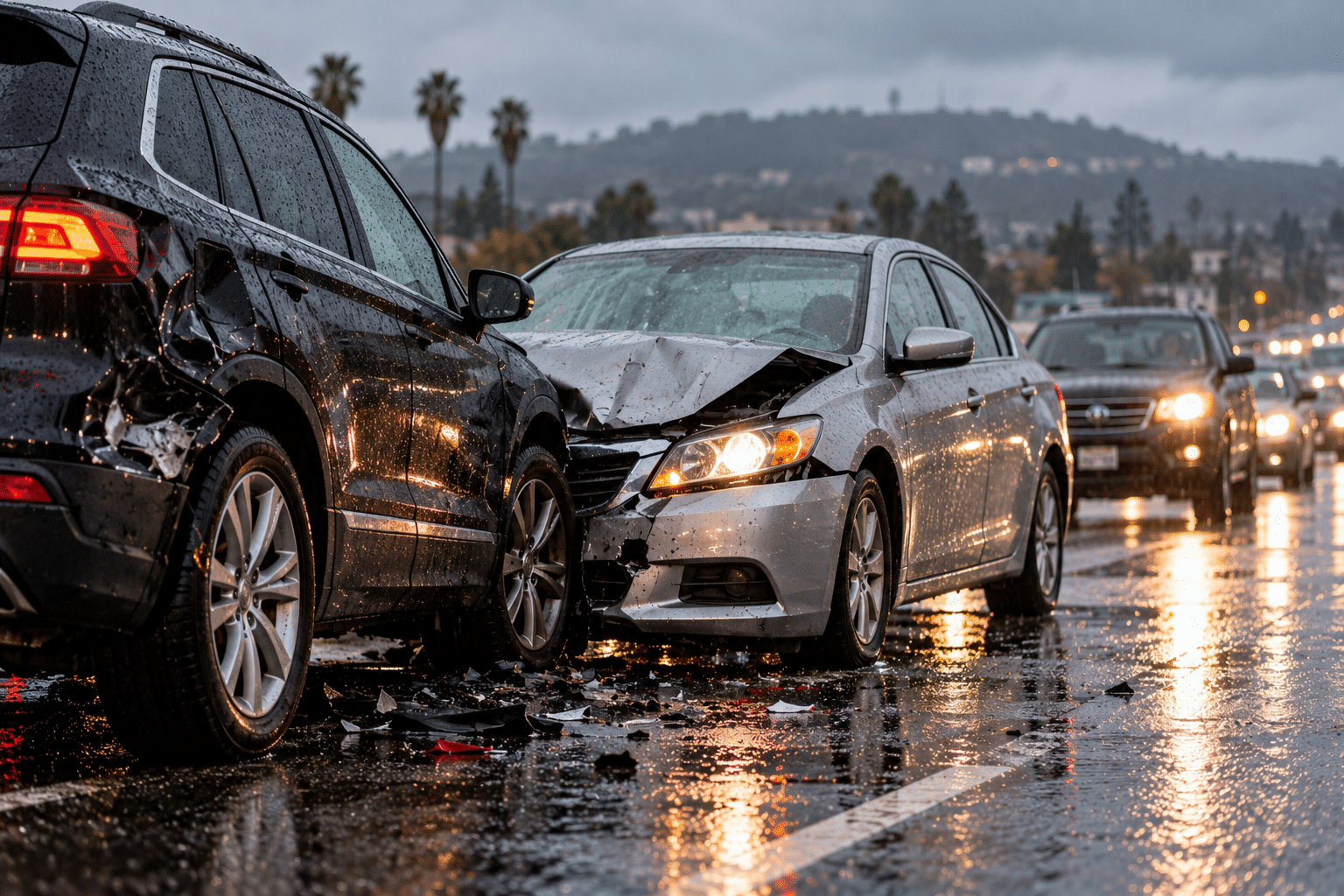
Rain car accident liability can become complicated when a driver blames slick pavement, poor visibility, or sudden weather for a collision. In California, that question becomes especially relevant when rain returns after a long dry period. Roads that felt predictable for months can suddenly become slippery, visibility can drop, and ordinary braking distances can change. Yet bad weather does not automatically mean that nobody is responsible for what happened.
After a wet-road collision, injured people often hear some version of the same explanation: “The road was slick.” It can sound reasonable enough that they begin to assume the crash was simply unavoidable. But rain car accident liability is not decided by weather alone. The more useful question is whether each driver adjusted their behavior to the conditions they could see and reasonably anticipate.
That distinction matters because a rainstorm can contribute to a crash without being the only cause of it. Speed, following distance, tire condition, visibility, braking, distraction, and lane changes can all become part of the analysis. When an insurance company focuses entirely on the weather, it may be leaving out the decisions that actually led to the collision.
Why California Roads Can Become Especially Slippery When Rain Returns
California drivers can go through long stretches without meaningful rain, which makes the first wet days of the season different from an ordinary rainy afternoon. During dry periods, dirt, dust, vehicle fluids, and other residue can accumulate on road surfaces. When rain finally arrives, that buildup can combine with water and reduce traction before repeated rainfall begins washing the roadway clean.
The California Highway Patrol’s wet-weather driving guidance explains that the first rains after an extended dry period can create particularly slippery conditions because rain mixes with accumulated dust, dirt, motor oil drippings, and oils associated with pavement. CHP also notes that rain reduces visibility, particularly at night, and wet pavement can reflect headlights in ways that make roadway markings more difficult to distinguish.
Those conditions are important when considering rain car accident liability because drivers are expected to respond to the roadway they actually have, not the roadway they wish they had. Someone traveling at a speed that felt comfortable during weeks of dry weather may need to slow down once traction and visibility change. A following distance that seemed adequate on dry pavement may no longer leave enough room to stop safely.
California law reflects that basic principle. California Vehicle Code Section 22350 prohibits driving at a speed greater than is reasonable or prudent while taking weather, visibility, traffic, and roadway conditions into account. Staying below the posted speed limit therefore does not necessarily mean that a driver was traveling at a safe speed for wet conditions.
For someone injured in a wet-weather collision, Maryam Parman’s auto accidents practice page provides additional context about how negligence, injuries, insurance coverage, and compensation can come together after a serious crash.
How Rain Car Accident Liability Is Evaluated After a Collision
Rain car accident liability usually requires looking beyond the fact that the pavement was wet. Investigators and insurers may consider vehicle speed, traffic flow, following distance, visibility, braking, lane position, tire condition, and whether the driver made a sudden maneuver. They may also examine whether the collision happened during active rainfall, shortly after rain began, or in standing water that created a hydroplaning risk.
Consider a rear-end collision during heavy rain. The striking driver might say the vehicle in front stopped suddenly and the road was too slick to brake in time. That explanation does not necessarily resolve the issue. If the driver was following too closely for wet conditions, traveling too fast, or distracted before braking, those choices may be more important than the rain itself.
A lane-change collision can present a different problem. A driver may lose traction while moving across lanes and argue that the vehicle unexpectedly slid. But the analysis may still consider how quickly the lane change was made, whether the driver accelerated during the maneuver, and whether the tires were capable of maintaining reasonable traction.
This is why rain car accident liability should be evaluated through evidence rather than assumptions. “It was raining” describes a condition. It does not explain everything a driver did before the impact.
That distinction is especially important when an insurer characterizes a crash as an unavoidable weather event before photographs, witness accounts, vehicle information, and other evidence have been fully considered.
Why This Matters in Real Wet-Road Accident Cases
Real cases rarely arrive with a neat explanation. A crash may involve several contributing circumstances at once, and rain car accident liability can become particularly contentious when each driver remembers the collision differently. One driver may insist they were moving slowly while another says the vehicle approached too quickly. Someone may claim they hydroplaned without warning, while physical evidence suggests they entered standing water at a speed that left little margin for correction.
A useful evaluation starts with what can actually be established. Photographs may show pooling water, tire marks, vehicle positions, impact damage, and lane configuration. Dash-camera or surveillance footage may reveal traffic speed and visibility. Witnesses may remember whether a vehicle was weaving, following closely, or moving noticeably faster than surrounding traffic. Weather information can help establish conditions at the relevant time rather than relying solely on someone’s recollection that it was “raining hard.”
Vehicle condition can also become important. Tires with inadequate tread may affect traction. Malfunctioning lights or worn windshield wipers may affect visibility. None of those facts automatically decides fault, but they can help explain why one driver lost control while others traveling through the same conditions did not.
The National Highway Traffic Safety Administration’s driving safety resources reinforce the broader principle that drivers need to account for roadway and environmental conditions. That is important in a liability investigation because the presence of rain does not remove the need for ordinary precautions behind the wheel.
That is also why Maryam looks beyond a simple weather explanation. If an insurance company treats rain as the end of the analysis, an injured person may never get a meaningful answer about whether another driver’s decisions contributed to the crash.
What People Often Misunderstand About Driving in the Rain
One of the biggest misconceptions about rain car accident liability is that a driver cannot be responsible if the vehicle hydroplaned. Hydroplaning describes what happened between the tires and the road surface; it does not automatically explain why it happened. Speed, tire condition, water depth, steering input, and other circumstances can all matter when evaluating a loss of traction.
Another misunderstanding is that driving under the posted speed limit automatically means the driver was being careful. California’s basic speed law makes weather and visibility part of the calculation. A posted limit may be legal under normal conditions while still being too fast for a particular stretch of wet pavement.
People also sometimes assume that rear-ending another vehicle in rain is excusable because stopping distance increased. Increased stopping distance is precisely why drivers may need to leave more space. CHP advises motorists in wet conditions to reduce speed, increase following distance, and avoid sudden stops or sharp turns.
Finally, there is a tendency to assume insurance companies will independently investigate every possible cause. In practice, an insurer may have little incentive to develop facts that increase its own policyholder’s responsibility. When rain car accident liability is disputed, preserving evidence early can be more important than waiting to see whether the adjuster eventually asks the right questions.
What Evidence Can Clarify Fault After a Rainy-Weather Crash
Evidence becomes particularly useful when rain car accident liability depends on competing explanations. If it is safe to do so, photographs taken soon after the collision can document standing water, roadway drainage, lighting, visibility, traffic controls, vehicle positions, and damage. Those conditions can change quickly once rain stops, traffic resumes, vehicles are moved, or water drains from the roadway.
Video may provide an even clearer picture. Dash cameras, traffic cameras, residential security systems, and nearby business cameras can sometimes show how vehicles were moving before impact. That footage can be especially valuable when a driver claims the vehicle suddenly lost control or when there is disagreement about speed, lane position, or following distance.
Vehicle evidence matters as well. Damage patterns can help establish the direction and location of impact. Tire condition may become relevant when loss of traction is disputed. In some serious collisions, additional vehicle information may help reconstruct what happened immediately before the crash.
Medical records serve a different purpose but are equally important. They establish what happened to the injured person after impact. Emergency care, diagnostic testing, follow-up appointments, physical therapy, and specialist evaluations can help document how the collision affected the person’s health and daily life.
Maryam Parman’s personal injury accidents page explains more about the broader role that evidence and damages can play when an injury claim extends beyond vehicle repairs.
When More Than One Factor Contributes to the Crash
Rain car accident liability does not always fit neatly into a single-cause explanation. A driver may be traveling too quickly while another makes an unsafe lane change. Standing water may contribute to a loss of control while worn tires make that loss of control more likely. Poor visibility may be present while a driver is also distracted. Serious collisions often involve a chain of events rather than one isolated mistake.
This is where overly simple insurance narratives can become a problem. Saying “the rain caused it” can obscure the decisions made before the collision. At the same time, blaming one driver without considering the actual road conditions can also oversimplify the case. A credible evaluation needs room for both the environmental conditions and human behavior.
That approach is particularly important when responsibility is disputed. Instead of trying to force the facts into a predetermined story, the better question is what each piece of evidence shows and how those pieces fit together. Maryam’s role is not to pretend weather does not matter. It is to make sure weather is not used as a convenient substitute for examining negligence.
For an injured person, that distinction can affect whether medical expenses, time away from work, pain, and future needs are taken seriously during settlement discussions.
Why Early Decisions Matter in Rain Car Accident Liability Claims
The first days after a wet-road collision can shape how rain car accident liability is ultimately understood. Physical conditions disappear quickly. Standing water drains. Rain stops. Debris is cleared. Vehicles are repaired. Surveillance footage may be overwritten. If the claim later turns into a dispute over what the roadway looked like, recreating those conditions can be much harder.
Statements can also shape the claim. Someone who has just been through a frightening crash may casually say, “I slid because of the rain,” without knowing whether another vehicle cut them off or whether other circumstances contributed. An insurer may later treat that comment as a complete explanation rather than an immediate reaction made under stress.
The same caution applies to injuries. Adrenaline can mask symptoms, and some problems become more noticeable after the initial shock has passed. Seeking appropriate medical care and accurately reporting symptoms creates a clearer record of what happened after the collision.
None of this means every rainy-day accident needs litigation or an elaborate investigation. It means important decisions should not be made before the basic facts are understood. When injuries are significant or responsibility is contested, early clarity can prevent a temporary weather condition from becoming a permanent explanation for a crash it did not fully cause.
FAQs About Rain Car Accident Liability
Does rain automatically make a car accident nobody’s fault?
No. Rain can contribute to a collision, but rain car accident liability still depends on driver behavior and the surrounding facts. Speed, following distance, visibility, braking, distraction, tire condition, and other circumstances may all matter.
Can a driver be at fault for hydroplaning?
Potentially. Hydroplaning itself does not automatically establish negligence, but investigators may consider speed, tire condition, standing water, and how the driver responded to the roadway.
What if the driver was below the posted speed limit?
That does not automatically mean the speed was reasonable. California Vehicle Code section 22350 requires drivers to consider weather, visibility, traffic, and roadway conditions when determining a safe speed.
Who is responsible in a rear-end crash during rain?
Responsibility depends on the facts. Wet pavement may increase stopping distance, but drivers are also expected to account for reduced traction by slowing down and leaving additional space.
Can poor tires affect rain car accident liability?
They can be relevant when traction or loss of control is disputed. Tire tread and condition may help explain why a vehicle lost traction, although they are only part of the overall analysis.
What should I photograph after a wet-road crash?
If it is safe, photographs can document vehicle damage and position, standing water, road surface conditions, drainage, lane markings, visibility, lighting, and nearby traffic controls.
Can a road condition contribute to a collision?
Potentially. Some cases may involve roadway drainage, standing water, construction, debris, or other conditions. Whether another party bears legal responsibility depends on the specific facts and applicable law.
What if the insurance adjuster says the rain caused the crash?
That conclusion should be evaluated rather than automatically accepted. Rain car accident liability may still involve negligent speed, following distance, distraction, unsafe maneuvers, or other driver decisions.
Contact Maryam Parman Today

Rain car accident liability can become confusing when an insurance company treats wet pavement as the entire explanation for a crash. Rain may have changed the road conditions, but that does not necessarily answer whether a driver was traveling too fast, following too closely, distracted, or otherwise failing to adjust to conditions.
If you were injured in a wet-road collision and are being told that the weather simply made the accident unavoidable, it may be worth looking more closely at what happened before accepting that conclusion. The evidence can tell a much more complete story than the weather report alone.
Rain car accident liability deserves a careful review when injuries, disputed fault, or insurance pressure are involved. Call now, start a live chat, or fill out a form to speak with Maryam Parman. Getting guidance early can help protect both your recovery and your financial future. Taking the right steps early not only protects your claim but also helps ensure that your recovery is supported financially and legally over time.
- Call Us: 844-672-7626
- Live Chat: Connect with us on our website for a case review.
- Fill Out a Form: Submit your details online for a free, no-obligation consultation.